
Learning from the best
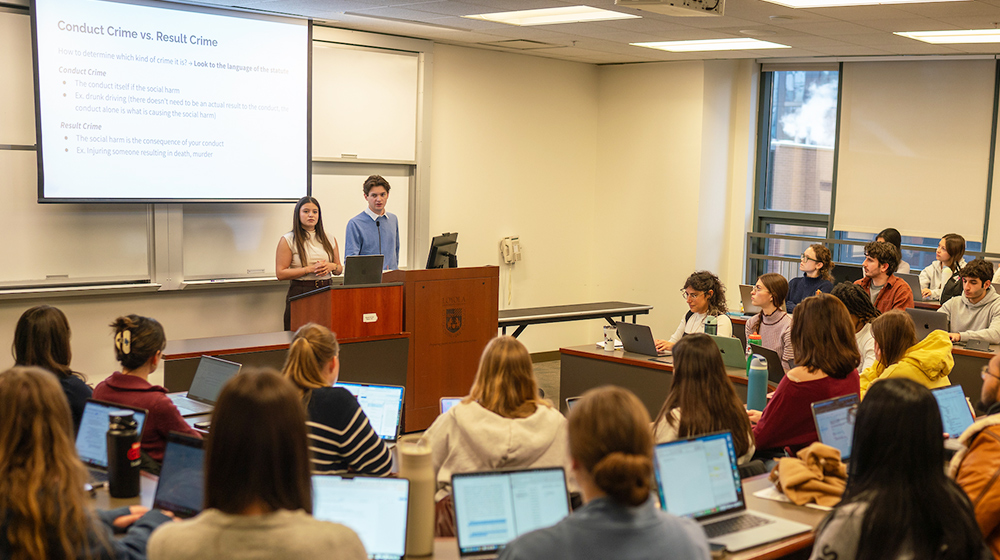
2Ls Oriana Mejia and Liam O’Connor lead a tutoring session for Distinguished Professor in Residence Maria Hawilo’s Criminal Law course.
Learning from the best
Student-led tutoring helps 1Ls thrive
There’s a lot to absorb as a new law student. From previously unknown terms (locus in quo, anyone?) to the intense reading load and fast pace, law school can quickly become overwhelming. That’s a key reason the School of Law offers an academic tutoring program specifically for 1Ls.
All first-year doctrinal courses, such as torts, property, and contracts, have 2L tutors assigned to them. Tutors host weekly, in-depth sessions to review complex material, practice hypotheticals, share outlining tips, answer questions, and offer advice.
“Our tutors did well in the subject, oftentimes with the same professor, the year before,” says Philip Bryans, assistant director of Academic Success and Bar Passage, who oversees the program. “Having been through it themselves, the tutors are uniquely equipped to support students through peer-to-peer learning.”
Cynthia M. Ho, Clifford E. Vickrey Research Professor and director of the Intellectual Property Program, always recommends the tutoring program to her civil procedure students. “I’m not trying to hide the ball,” she says. “The students who succeed are the ones who attend. It’s voluntary, but it’s to your benefit, and it’s another way Loyola ensures that students have the tools they need to succeed.”
Although exact numbers aren’t known, not every law school offers a formal academic tutoring program. And among those that do, Loyola’s robust program stands out. Lydia Panton, a 2L who served as a tutor for Associate Professor Sheldon Bernard Lyke’s property course in fall 2025, noticed this difference while touring law schools.
“A few other schools had teaching assistant programs, but I could tell that Loyola really cared about providing resources to 1Ls,” she says. “I could sense that it was a value here, and I liked that.”
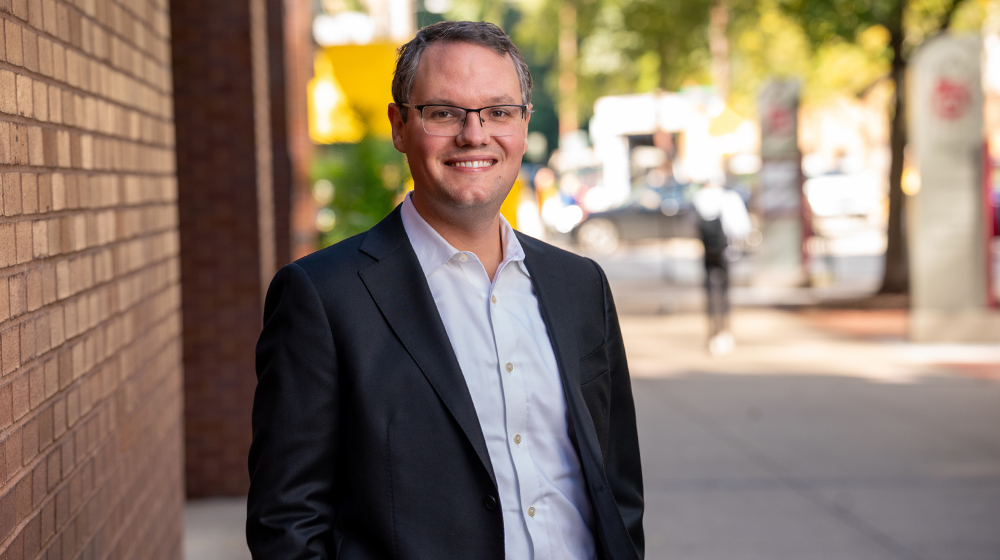
Philip Bryans oversees the School of Law’s tutoring program. “The tutors are uniquely equipped to support students through peer-to-peer learning,” he says.
Academic Scaffolding
1L Creighton Foulkes, who previously worked in tech, recalls feeling inundated at the beginning of the semester. “I hadn’t been in school for a while,” he says. “I didn’t even know how to take the right kind of notes.” He asked his civil procedure tutor for guidance, and, as the weeks went by, Foulkes found additional benefits from attending tutoring sessions.
“For torts, I sent the tutor one of my weekly hypothetical essays, and he provided really helpful feedback,” Foulkes says, adding that he often asked tutors to review his outlines as well. Additionally, Foulkes and his classmates used tutoring sessions to pose questions that were outside the scope of in-class discussion.
“Things like, ‘How did you study for this exam? When did you start preparing?’” Foulkes says. “Just the fact that they’ve been in our shoes and were successful meant they could really help us.”
Not every law school offers a formal academic tutoring program. And among those that do, Loyola’s robust program stands out.
Panton, who had worked as a teaching assistant at Northwestern University, welcomed questions during her tutoring sessions. “There can be a frenetic energy in the 1L year,” she says. “I talked a lot about lowering the temperature.” She reassured students with her calm demeanor and straightforward PowerPoint presentations followed by a practice problem and discussion.
Thanks to Panton’s strategies, 1L Elisa Dettloff gained a better grasp of complicated concepts. “A lot of us learn by doing, so she would bring in examples that she had created with Professor Lyke,” says Dettloff. “You can’t do as much hands-on learning in a classroom setting because there’s so many of us, but in tutoring, you can get an individualized approach to difficult topics.”
Dettloff, who called the tutoring sessions a “game changer,” earned an A in property and is hoping to be a tutor next semester.
Tutors attend all the classes for their assigned course and receive academic credit through the program. They work closely with the professors, who often meet weekly with their tutors or collaborate regularly over email. “Tutors serve an important intermediary role, and I consider them to be on the same team as me,” says Ho. “There’s less I need to do in class in terms of clarifying material because the tutors have already done that.”
Consequently, class time can be more focused and efficient, as Panton notes: “When I can support the 1Ls and resolve lower-level misunderstanding, that paves the way to get more in-depth and complex in class.”
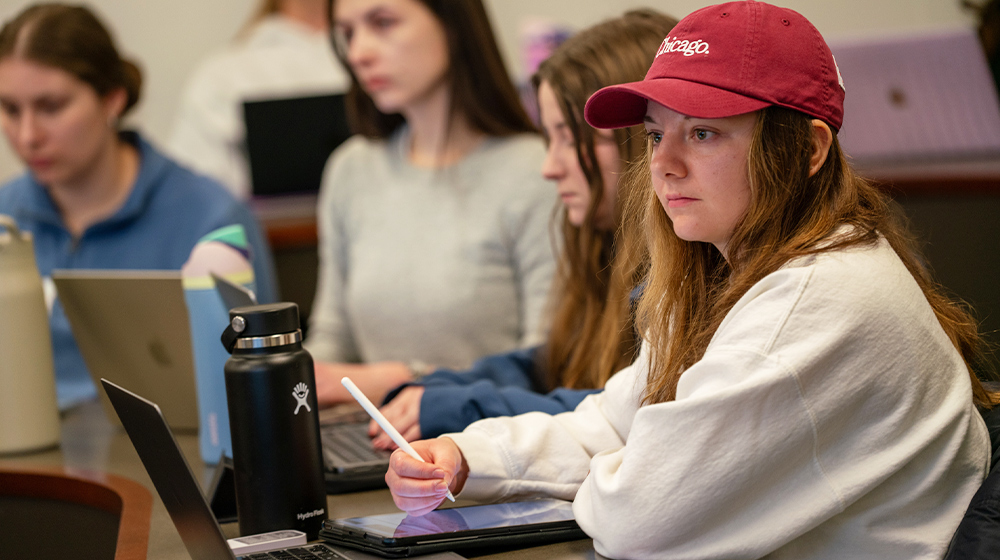
1Ls attend tutoring sessions to dig into complex material, practice hypotheticals, and receive advice from 2L tutors who did well in the subject the previous year.
Built-in Mentorship
Tutors serve a vital role in supporting academic success—but they also become mentors for 1L students navigating all aspects of law school. 2L Lauren McCabe Chambers, a tutor for Assistant Professor Richard M. Weinmeyer’s torts class, notes that she developed connections with first-generation law students in her tutoring sessions.
“I could relate to them since I’m also a first-generation law student,” McCabe Chambers says. “I tried to be a resource when they faced challenges, whether it was impostor’s syndrome, where to look for a summer job, or how to access study guides at the library.”
“It’s important that 1Ls know they are being supported not only by faculty members but also by their fellow students.”
Weinmeyer touts the tutoring’s peer-to-peer model as one of its key benefits. “We want students to find community when they come here,” he says. “It’s important that 1Ls know they are being supported not only by faculty members but also by their fellow students.”
While 1Ls don’t typically interact much with 2Ls and 3Ls, the tutoring program facilitates valuable conversations across class years. For example, McCabe Chambers, a ChildLaw Fellow and former educator who serves on the board of SUFEO, recruited a 1L to join this student-run advocacy organization that supports PreK-12 students in Illinois.
“She had worked with kids before but had never heard of education law,” McCabe Chambers says. “I was thrilled to introduce her to this potential legal career and excited when she decided to volunteer with SUFEO.”
For Weinmeyer, that story perfectly exemplifies the Loyola Law ethos. “There can be a certain sink-or-swim, individualistic mentality when it comes to law school, but at Loyola, that just doesn’t make a lot of sense,” he says. “People are coming here from all walks of life. I think the tutoring program is a must-have—not only for the academics but to start building a network in law school and beyond.” –Kelsey Schagemann (January 2026)
There’s a lot to absorb as a new law student. From previously unknown terms (locus in quo, anyone?) to the intense reading load and fast pace, law school can quickly become overwhelming. That’s a key reason the School of Law offers an academic tutoring program specifically for 1Ls.
All first-year doctrinal courses, such as torts, property, and contracts, have 2L tutors assigned to them. Tutors host weekly, in-depth sessions to review complex material, practice hypotheticals, share outlining tips, answer questions, and offer advice.
“Our tutors did well in the subject, oftentimes with the same professor, the year before,” says Philip Bryans, assistant director of Academic Success and Bar Passage, who oversees the program. “Having been through it themselves, the tutors are uniquely equipped to support students through peer-to-peer learning.”
Cynthia M. Ho, Clifford E. Vickrey Research Professor and director of the Intellectual Property Program, always recommends the tutoring program to her civil procedure students. “I’m not trying to hide the ball,” she says. “The students who succeed are the ones who attend. It’s voluntary, but it’s to your benefit, and it’s another way Loyola ensures that students have the tools they need to succeed.”
Although exact numbers aren’t known, not every law school offers a formal academic tutoring program. And among those that do, Loyola’s robust program stands out. Lydia Panton, a 2L who served as a tutor for Associate Professor Sheldon Bernard Lyke’s property course in fall 2025, noticed this difference while touring law schools.
“A few other schools had teaching assistant programs, but I could tell that Loyola really cared about providing resources to 1Ls,” she says. “I could sense that it was a value here, and I liked that.”
Academic Scaffolding
1L Creighton Foulkes, who previously worked in tech, recalls feeling inundated at the beginning of the semester. “I hadn’t been in school for a while,” he says. “I didn’t even know how to take the right kind of notes.” He asked his civil procedure tutor for guidance, and, as the weeks went by, Foulkes found additional benefits from attending tutoring sessions.
“For torts, I sent the tutor one of my weekly hypothetical essays, and he provided really helpful feedback,” Foulkes says, adding that he often asked tutors to review his outlines as well. Additionally, Foulkes and his classmates used tutoring sessions to pose questions that were outside the scope of in-class discussion.
“Things like, ‘How did you study for this exam? When did you start preparing?’” Foulkes says. “Just the fact that they’ve been in our shoes and were successful meant they could really help us.”
Panton, who had worked as a teaching assistant at Northwestern University, welcomed questions during her tutoring sessions. “There can be a frenetic energy in the 1L year,” she says. “I talked a lot about lowering the temperature.” She reassured students with her calm demeanor and straightforward PowerPoint presentations followed by a practice problem and discussion.
Thanks to Panton’s strategies, 1L Elisa Dettloff gained a better grasp of complicated concepts. “A lot of us learn by doing, so she would bring in examples that she had created with Professor Lyke,” says Dettloff. “You can’t do as much hands-on learning in a classroom setting because there’s so many of us, but in tutoring, you can get an individualized approach to difficult topics.”
Dettloff, who called the tutoring sessions a “game changer,” earned an A in property and is hoping to be a tutor next semester.
Tutors attend all the classes for their assigned course and receive academic credit through the program. They work closely with the professors, who often meet weekly with their tutors or collaborate regularly over email. “Tutors serve an important intermediary role, and I consider them to be on the same team as me,” says Ho. “There’s less I need to do in class in terms of clarifying material because the tutors have already done that.”
Consequently, class time can be more focused and efficient, as Panton notes: “When I can support the 1Ls and resolve lower-level misunderstanding, that paves the way to get more in-depth and complex in class.”
Built-in Mentorship
Tutors serve a vital role in supporting academic success—but they also become mentors for 1L students navigating all aspects of law school. 2L Lauren McCabe Chambers, a tutor for Assistant Professor Richard M. Weinmeyer’s torts class, notes that she developed connections with first-generation law students in her tutoring sessions.
“I could relate to them since I’m also a first-generation law student,” McCabe Chambers says. “I tried to be a resource when they faced challenges, whether it was impostor’s syndrome, where to look for a summer job, or how to access study guides at the library.”
Weinmeyer touts the tutoring’s peer-to-peer model as one of its key benefits. “We want students to find community when they come here,” he says. “It’s important that 1Ls know they are being supported not only by faculty members but also by their fellow students.”
While 1Ls don’t typically interact much with 2Ls and 3Ls, the tutoring program facilitates valuable conversations across class years. For example, McCabe Chambers, a ChildLaw Fellow and former educator who serves on the board of SUFEO, recruited a 1L to join this student-run advocacy organization that supports PreK-12 students in Illinois.
“She had worked with kids before but had never heard of education law,” McCabe Chambers says. “I was thrilled to introduce her to this potential legal career and excited when she decided to volunteer with SUFEO.”
For Weinmeyer, that story perfectly exemplifies the Loyola Law ethos. “There can be a certain sink-or-swim, individualistic mentality when it comes to law school, but at Loyola, that just doesn’t make a lot of sense,” he says. “People are coming here from all walks of life. I think the tutoring program is a must-have—not only for the academics but to start building a network in law school and beyond.” –Kelsey Schagemann (January 2026)